IAB Europe gives publishers a 90-day plan for AI agents, access rules and licensing
IAB Europe's new playbook gives publishers seven AI access rules, six ways to get paid and a 90-day plan. What it says and what small outlets can use.
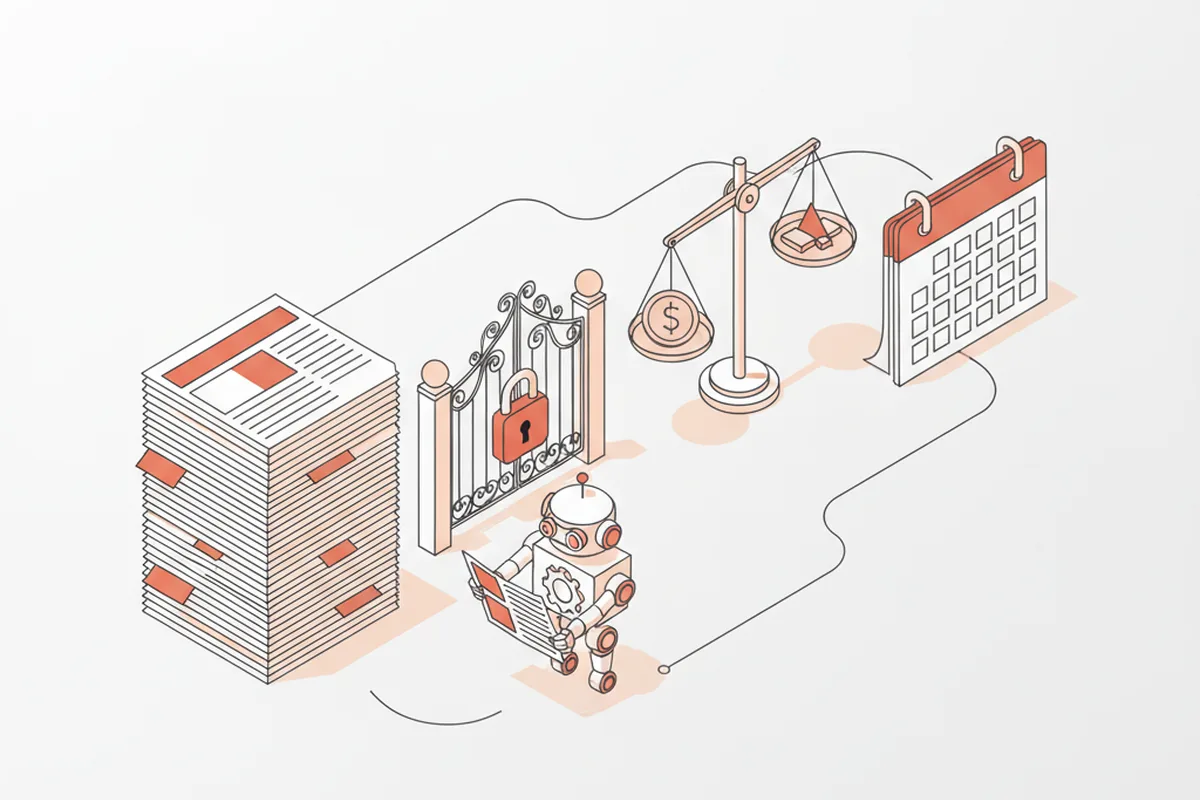
IAB Europe released a free Publisher Playbook for the Agentic Web on November 26. It is an interactive guide for news and media companies that have to decide what AI systems may do with their content and how to get paid for it. The trade body's Publisher Content and AI Task Force and its AI Working Group built it with input from BVDW, the German digital industry association. PPC Land reported that the work was co-led by Katharina Schneeberg of BVDW and Tobias Kellner of Google.
The playbook runs to 22 slides in five chapters: Know Your Position, Decide Access, Get Paid, Run It and Industry Asks. It is written for commercial, editorial, legal, product and ad operations teams. It does not recommend one strategy, and it sets no prices or contract terms. Its scores, sliders and checklists run in the browser, and IAB Europe says nothing a user enters leaves the page.
Most of the choices in the playbook assume a publisher can see which bots arrive, tell them apart and serve each one differently. Large groups have teams for that. A small newsroom usually does not, and an outlet that wants to build its own answer engine on top of its archive, instead of only licensing that archive to outside labs, will usually hire an AI development company or a freelance engineer rather than do it in-house.
What does the playbook cover?
It starts with a self-assessment. A publisher scores 12 areas from 0 to 3, for a maximum of 36, to see how much of its revenue is exposed as readers move from browsing to asking chatbots and then to handing tasks to AI agents. It then asks the publisher to sort automated traffic and set a separate rule for each of seven kinds of AI use:
- Model training on the publisher's articles.
- Indexing and discovery, so the content can be found.
- Grounding and live retrieval, when a chatbot pulls a fresh article to answer a question.
- Entity extraction of names, places and facts.
- Agent viewing, when an AI agent reads a page for a user.
- Agent action, when an agent does something on the site, such as subscribe or buy.
- Advertising use of the content in AI environments.
The point of splitting them is that a single yes or no in robots.txt is too blunt. A publisher might want to be found by AI search, refuse training and charge for live retrieval. The playbook also has a section on the side effects of blocking, since a closed door can cost referral traffic as well as protect content.
How can publishers get paid?
The Get Paid chapter lists six licensing models:
- Flat licence: a fixed fee for access.
- Usage licence: payment per use.
- Hybrid: a minimum fee plus usage.
- Subscription embedding: the publisher's paid product is offered inside the AI service.
- Attribution licence: payment tied to credit and links.
- Outcome licence: payment tied to results such as sign-ups.
It adds 13 due-diligence questions for any AI deal, from scope and purpose to data retention, measurement, advertising terms and how a dispute would be proven. The playbook also keeps AI discovery, which it ties to generative engine optimization, separate from licensing. Showing up in AI answers and getting paid for content are two different goals.
To show why the money question matters, the playbook cites crawl-to-referral ratios measured in July 2025: about 38,065 crawler requests per visit sent back for Anthropic, 1,091 for OpenAI and 5.4 for Google. Its worked example uses 120,000 crawler requests against 800 referral visits, a ratio of 150 to 1.
What is in the 90-day plan?
The Run It chapter has 21 actions split into three 30-day phases:
- Days 1 to 30. Name who owns the decision, classify bot traffic, record baseline metrics, take stock of the rights you actually hold, map your technical controls and list current partners.
- Days 31 to 60. Pick a stance for each AI use, design the products you would license, protect direct reader journeys, test advertising and set approval gates.
- Days 61 to 90. Launch one pilot, track access, check whether it adds revenue or only moves it, validate reporting and decide the next step.
What does this mean for small and independent publishers?
For a newsletter or a small site, the first 30 days of the plan are the useful part:
- Check your server logs for AI crawlers.
- Write down which of the seven uses you accept, and make sure your terms of use say so.
- Set your bot rules to match, the way The Wall Street Journal now blocks bots by default.
The playbook comes out while publishers are already pushing back on platforms. Meta paused its proposed business terms, which would have let it scrape websites linked to business accounts, after protests from news groups, Nieman Lab reported. Large outlets are signing their own deals, as in our report on Le Figaro's agreement with OpenAI. US publishers should also follow the Stealth Bot Prohibition Act, a Senate bill that would make bots that burden websites disclose who runs them.
Sources for this report
- IAB Europe: Publisher Playbook for the Agentic Web (Nov. 26, 2026)
- IAB Europe: the interactive playbook
- PPC Land: IAB Europe gives publishers a 90-day plan for AI bots, deals and ads
- Affiverse Media: IAB Europe launches AI content monetization playbook
- Nieman Lab: Meta pulls down controversial terms of service